Christopher Nolan's film of The Odyssey and its Locations in the Mediterranean
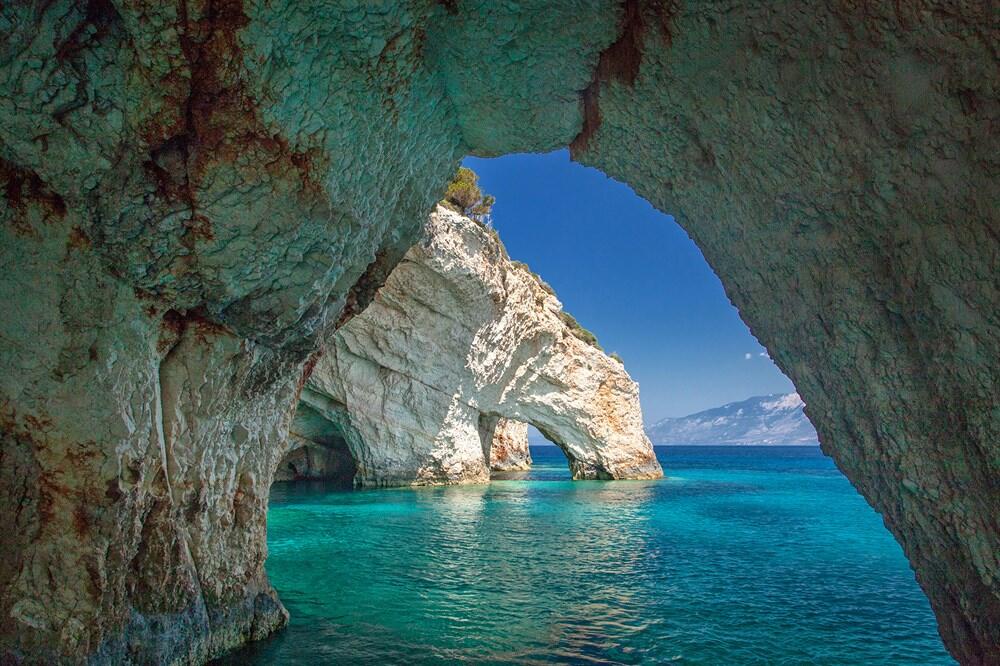
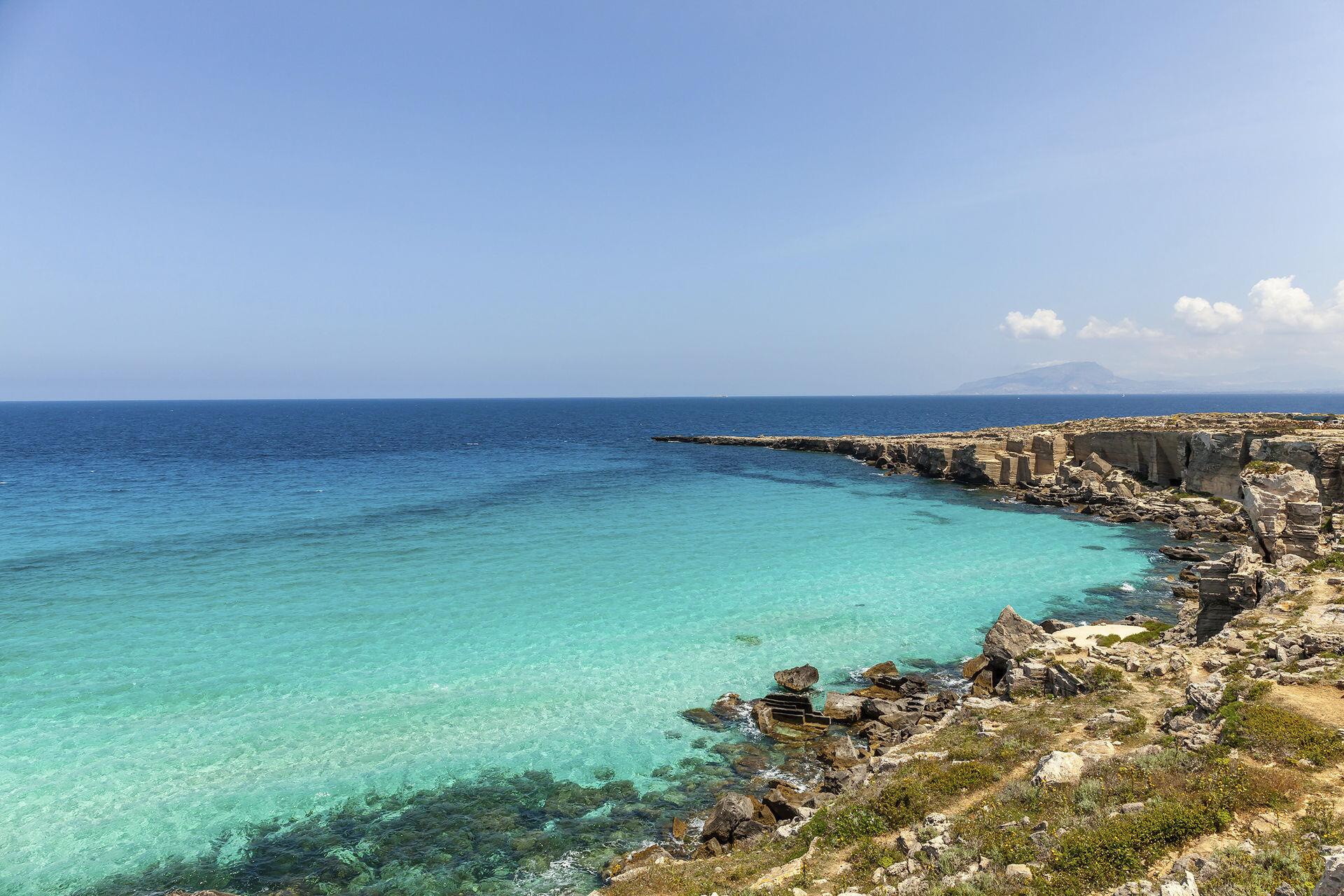
The irresistible waters of Cala Rossa on Favignana, the Egadi Islands.
Favignana, the Egadi Islands
In the film
Favignana, the largest of the three Egadi Islands located just off the west coast of Sicily, is one of the major locations of The Odyssey. Nolan, his crew and his cast of around 500 practically took over the main town and spent several months filming scenes there and around the island's paradisiacal coves. One landmark that made the final cut is the Castello di Santa Caterina, a fortress, once Saracen then Norman, that rises high on a hill above the harbour. In the film it stars as the home of Penelope, Odysseus' long-suffering, long-waiting wife.
In the book
Favignana’s long history has a Greek chapter, and some even say that it features in Homer’s original epic as the place Odysseus stopped off to rest, feast on goat (the Greek name for Favignana was Aegusa - Goat Island), and stock up on supplies for the voyage ahead.
Why visit
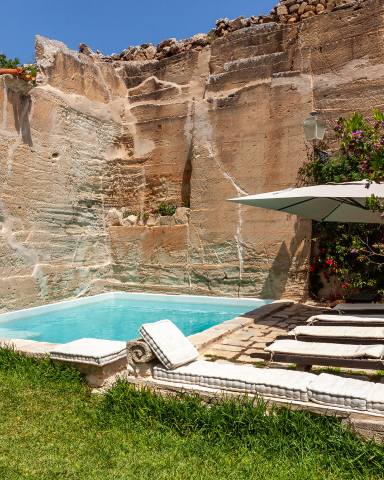
Loved by Sicilians and Italians in the know, Favignana is home to idyllic beaches, a rugged coastline, and coves of electric blue waters that take the breath away. The archipelago’s history includes several major events, including a series of naval battles during the First Punic War between Rome and Carthage. The Romans quarried tuff stone on Favignana and the island is riddled with quarries, one of which, above the mythically beautiful bay of Cala Rossa, hosts the gardens and pool of our very own island retreat, Zu Nillu. Just across the water is another of the Egadi Islands, Marettimo, a paradise for swimmer, walkers and off-the-beaten-trackers. The place to stay there is our lovingly restored fisherman’s cottage, Hiera.


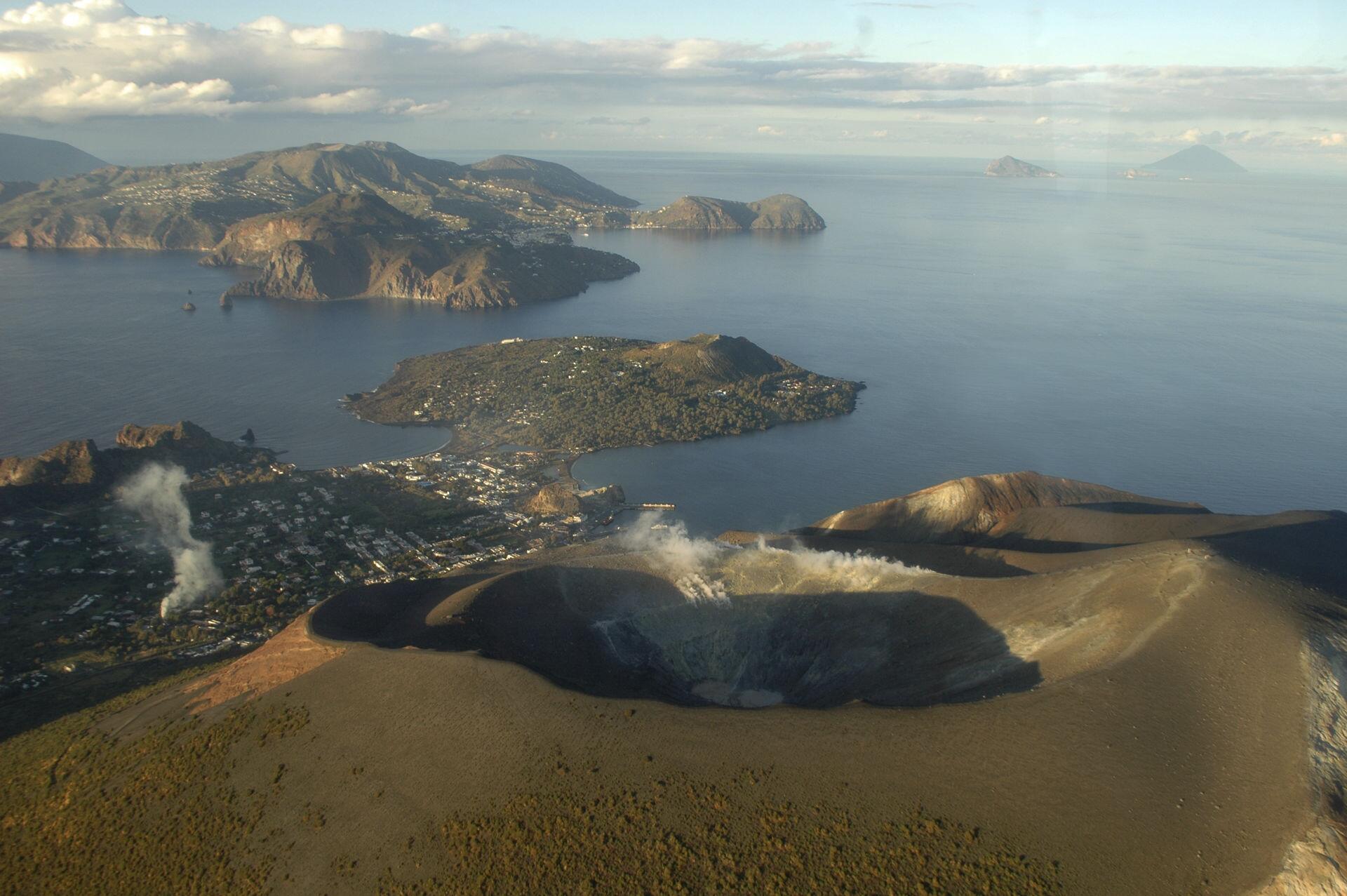
Flying above Vulcano in the Aeolian Islands.
The Aeolian Islands
In the film
The Aeolian Islands are located off the north coast of Sicily. Like the Egadis, they have a history that spans many millennia. Volcanic in origin (two of the islands are still active volcanoes), they were settled by Greeks over 2,500 years ago. Nolan and co filmed several scenes there, including on Lipari (the main island), Basiluzzo (a tiny islet looking out towards the perpetual eruptions of Stromboli) and Vulcano, whose smoking, sulphurous crater and bubbling mud baths are striking. In the film, the floating island home of King Aeolus, guardian of the winds, was shot in the surrounding seas.
In the book
According to legend, the keeper of the winds, Aeolus, presided over the archipelago that takes his name. In Homer’s original, Aeolus, wishing to help Odysseus on his voyage home, presented him with a bag containing all the world's winds. Unfortunately, when within shouting distance of Odysseus' home on Ithaca, one of the crew opened the bag and the uncontrollable winds drove our poor hero all the way back to the Aeolian Islands.
The Aeolian island of Salina, known to the Greeks as Didyme (the Twins), is thought by some scholars to be the home of Circe, the sorceress who transformed Odysseus’ crew into pigs. After a year-long affair, Odysseus persuades her to reverse her spell on his men.
Why visit
The seven main islands that make up the Aeolian Islands are bewitching. Each one, from tiny, car-free, chic Panorea to buzzing Lipari, with its world-class archaeological museum, is a world unto itself. The surrounding seas are rich in marine life, the lava-sand beaches are glorious, the wine and the cuisine are delicious, the views are awe-inspiring, and the walking is highly rewarding. No wonder the archipelago is a UNESCO World Heritage Site.
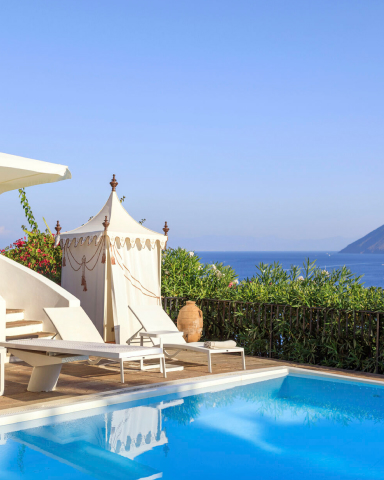
Antika and Posidonia, our villas on Panarea and Lipari respectively, provide the perfect bases for exploring it all.

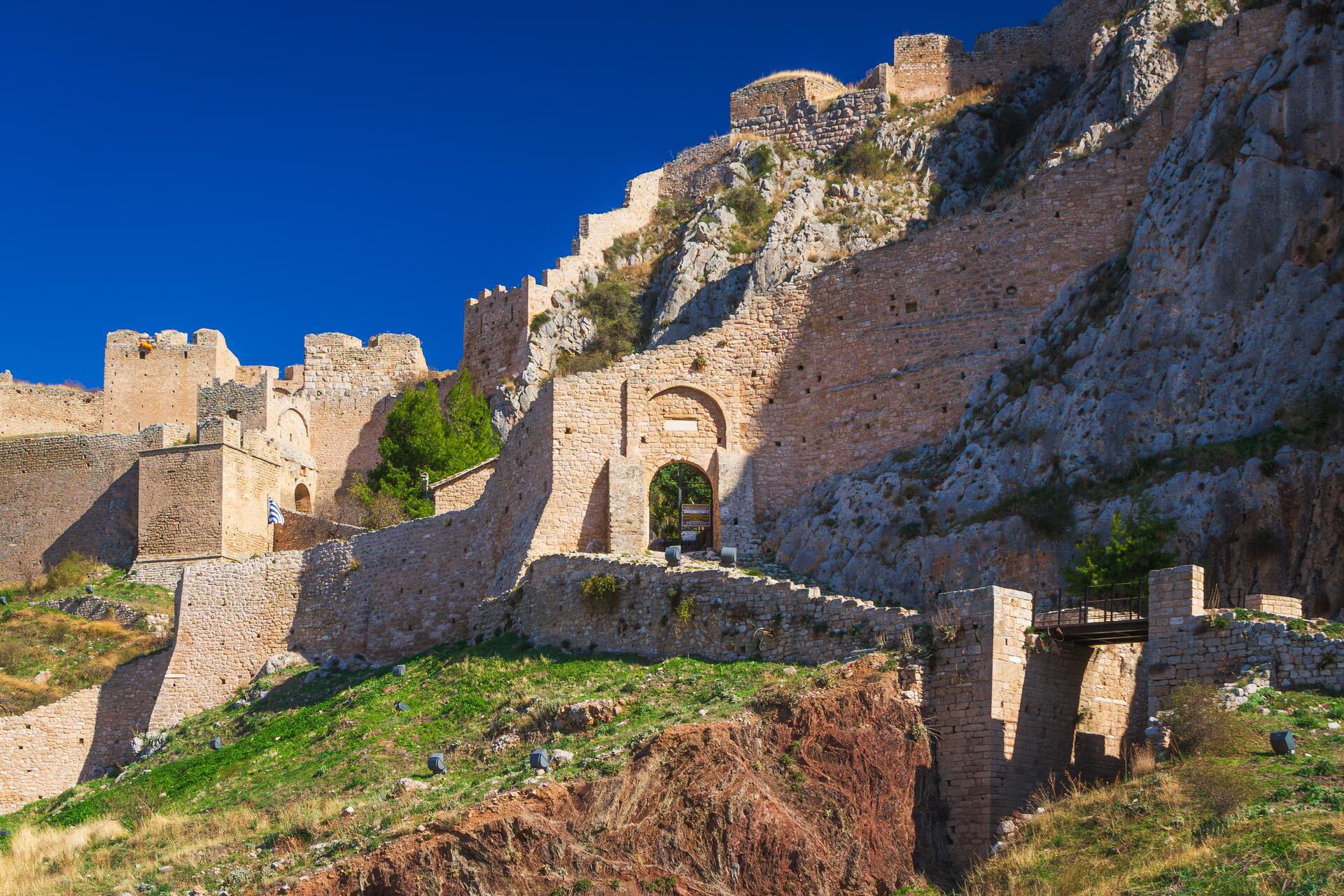
The mighty ancient fortifications of Acrocorinth in the Peloponnese.
The Peloponnese
In the film
Greece’s many-fingered peninsula, the Peloponnese, has an ancient, timeless feel, with an unspoilt, mountainous hinterland, a beach-fringed coastline of incredible variety, and numerous towns and villages that evoke legendary stories and mythical adventures.
Nolan spent considerable time there, filming in several places.
Perhaps most impressive amongst the locations chosen in the Peloponnese is the incredible fortification of Acrocorinth, whose mighty walls wrap around a hillside and a rocky outcrop rising over 500m above sea level.
From the northeast of the Peloponnese, the troupe headed to the southwest to the town of Pylos and the area of Messenia. For the scene in which Agamemnon returns to his wife, Clytemnestra, they filmed at Methoni Castle, which is surrounded by the sea and connected to a slender promontory by a little bridge, and the perfectly semi-circular sandy beach of Voidokilia.
Overlooking the aforementioned beach is Nestor's Cave, where the scenes featuring the Cyclops and Odysseus were shot.
In the book
In Homer’s original, there are a couple of significant moments set in the Peloponnese. The first is a terrible tempest at Cape Malea at the southeasternmost tip of the peninsula. This storm once more delays our hero’s journey home by blowing him hundreds of miles off course to the land of the Lotus Eaters.
The second recounts the journey of Odysseus' son, Telemachus, who sets out on a mission to find his father. He visits the great Mycenaean Palace of Nestor, which rises on a hill some 12km due north of Pylos. Still visitable today, the palace is one of Greece’s many exceptional archaeological wonders.
Why visit
The Peloponnese are imbued with pure Greek spirit and the rugged landscapes of the interior seem unchanged since ancient times. Mountains plunge into deep valleys, torrents fill and flow from autumn to spring, olive trees grow wild and untamed, mule tracks weave their way between stone-silent villages, Arcadian meadows burst with wild flowers, and people still live off the land, cultivating their own fruit and vegetables, and foraging for flavour-filled greens.
Down by the coast, beach after beach, many tantalisingly uncrowded even in the summer months, provide carefree moments for those willing to explore.
The evocative names of the region’s towns and archaeological sites take us step by step through Greece’s immensely rich history: Mycenae, Argos, Corinth, Olympia, Sparta, and Epidaurus transport us back to classical times; Ottoman Mystras and Venetian Monemvasia tell of foreign dominations; Kalamata and Nafplion, the latter Greece’s first capital after independence in 1828, resonate with national pride.
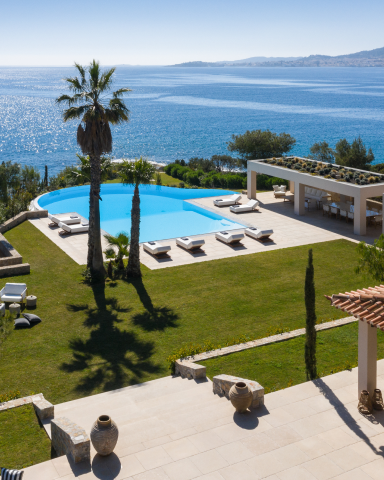
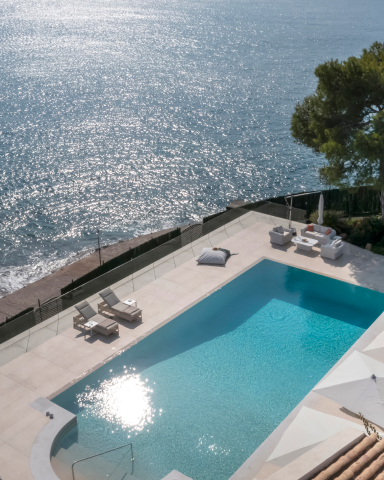
Our villas in the Peloponnese are centred around Porto Heli and Corinth and many of the places mentioned above are reachable from them.


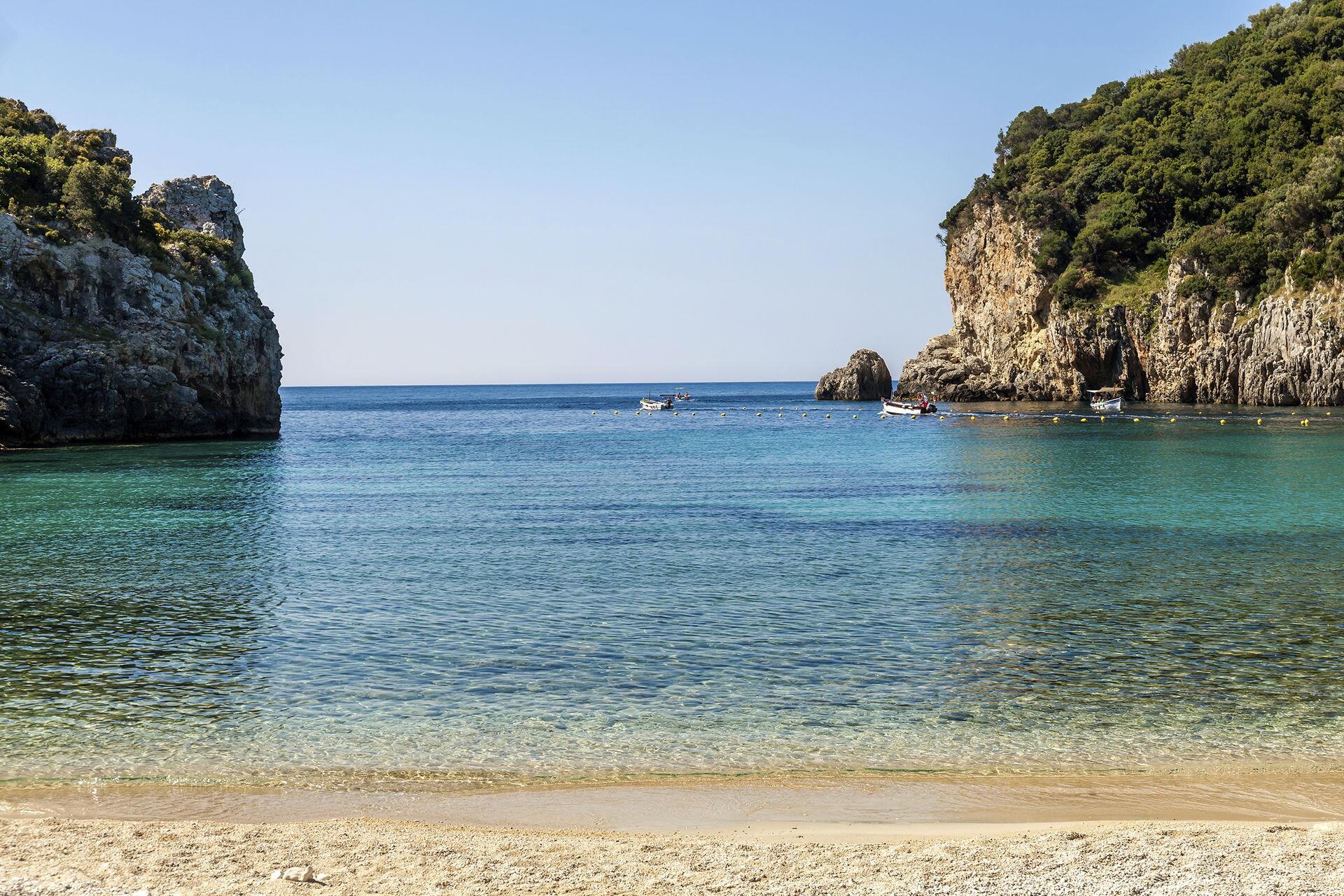
Beautiful Paleokastritsa beach in northeast Corfu.
Our other Homeric destinations
Corfu
After fleeing from Calypso, Odysseus suffered a shipwreck and was washed up unconscious on the beach of Paleokastritsa in northwest Corfu. He eventually awoke to find Nausicaa, the daughter of King Alcinous of Phaeacia, standing over him. The king allowed him to stay and recover, and Odysseus earned his keep by regaling the court with tales of his adventures.
Sicily
One of the stories Odysseus recounted to the Phaeacians documented his exploits in and around Sicily, where he had sailed past Scylla (a six-headed monster) and Charybdis (a whirlpool) in the Straits of Messina, and escaped from Polyphemus’ cave on Mount Etna.
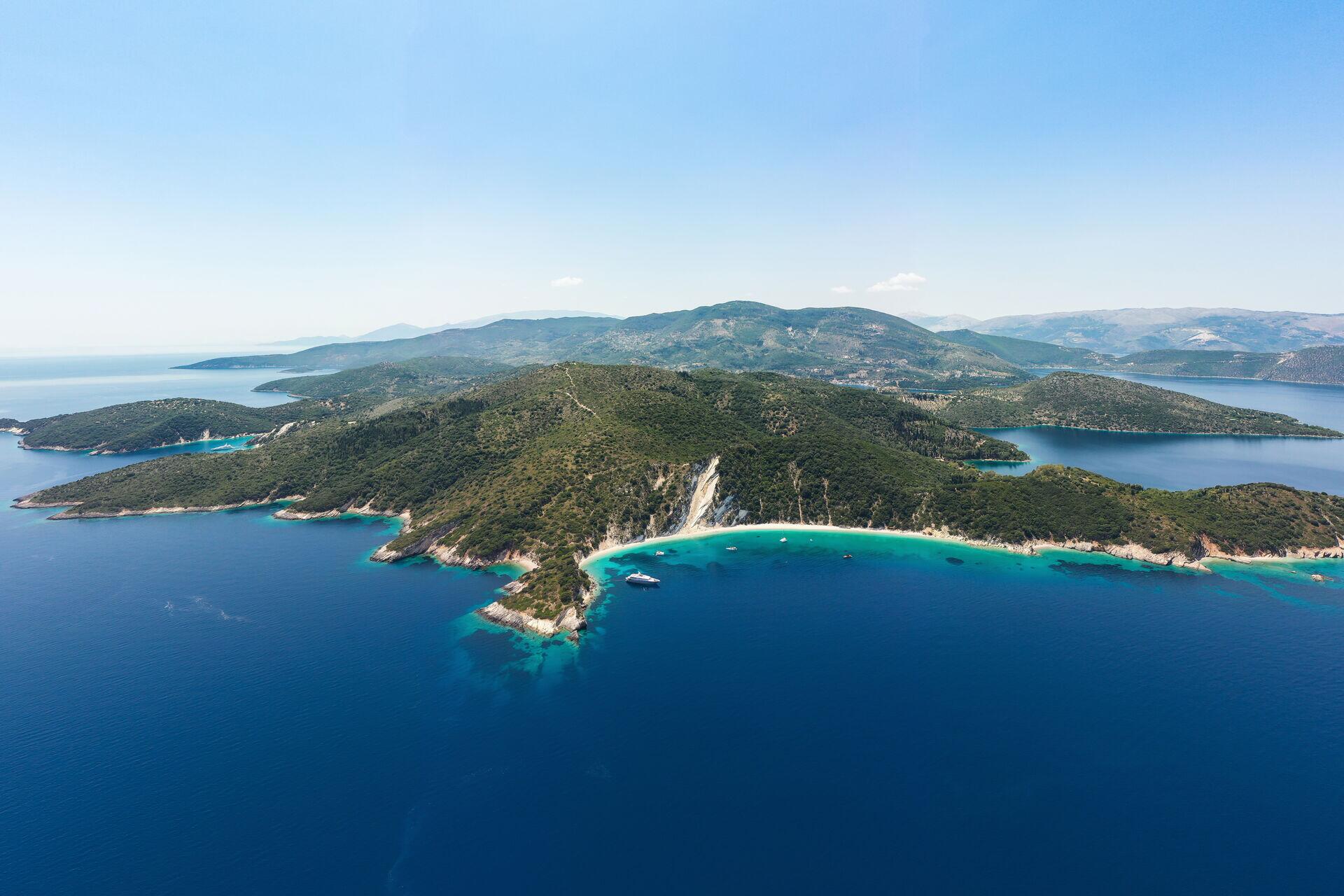
Ithaca, one of the Ionian Islands off the west coast of Greece.
Ithaca or not Ithaca - where was Odysseus from?
Luminous Ithaca is my home. Its mountain, leaf-fluttering Neriton, is visible from afar.
Lying near Ithaca are its sister islands, Doulichion, Same and forested Zakynthos.
Ithaca herself lies low, closest to the sea, facing dusk, while the others look out to dawn and the rising sun.
It is a harsh environment, but produces fine men.
Thus Odysseus described his island home. Or so we think. Scholars have never agreed on how exactly to translate the passage above, and there is no consensus as to whether modern-day Ithaca was, in fact, Odysseus’ home.
The case for Ithaca
The German archaeologist, H. Schliemann, achieved relative fame for his tireless excavations on Ithaca. He unearthed numerous archaeological treasures bearing Mycenaean Greek depictions of and inscriptions alluding to the great hero, all of which convinced him of two things: first, Odysseus hailed from modern-day Ithaca; second, Odysseus was a real person, not merely a Homeric invention.
The argument for Lefkada
William Dörpfeld, who had started his career as an assistant to Schliemann, had a different theory. For him, Homer’s hero was a native of Lefkada. Dörpfeld’s hypothesis was based on his study of the Odyssey, with particular reference to the verses in which the shipwrecked Odysseus describes his beloved homeland to the King of the Phaeacians. Dörpfeld began excavating on Lefkada in 1900 and continued until 1910, during which time his discoveries, ideas and opinions caused something of a schism in the world of archaeology. In 1927, he published a summary of his theories, though there was still no absolute proof that King Odysseus was a native of Lefkada.
Or could it be Kefalonia?
Captain Corelli might be most associated with Kefalonia in the modern imagination, but according to some, the most enduring literary character in the island’s multi-millennial history is in fact Odysseus. “But what about Ithaca and Lefkada?”, you might ask. Well, many experts believe that Odysseus’ description of his home island (see the opening quote) doesn’t tally with the actual geographical position or topography of Ithaca. In his 2005 book, Odysseus Unbound, Robert Bittlestone argues that Kefalonia’s northern Paliki peninsula is a much closer match to Homer’s Ithaca than the Ithaca we know today. The narrow strip of land connecting the peninsula to the main body of Kefalonia, says Bittlestone, was once submerged, meaning that in Homer’s times Paliki had been an island in its own right. Geological surveys support this theory, demonstrating that a series of earthquakes later caused tectonic uplift of the seabed, effectively raising it above sea level until the two islands were linked.



We're Villa Matchmakers
Because our local experts have personally visited each of our destinations, we know exactly what makes them special. Tell us what your ultimate villa holiday looks like, and allow us take care of the rest.