Areas of Sardinia
Places to visit in Sardinia
As the second largest island in the Mediterranean, Sardinia (Sardegna in Italian) boasts a vast array of places to visit, including myriad beaches, bustling cities, tranquil towns, sleepy villages, mountain ranges, and ancient archaeological sites. Its islands are also not to be missed.
Below you'll find an introduction to a few areas of Sardinia, with a particular focus on our Costa Smeralda villas and the south coast.
The Costa Smeralda
If it didn't exist, you'd have to invent it
The Costa Smeralda is a figment of the imagination, a topographical mirage, a make-believe wonderland. Even today, you won't find the name on official maps, and its absence in any guidebook published before the 1960s is revealing. Quite simply, it didn't exist until it was invented and registered as a trademark at the Central Patent Office in 1963.
Enter the Aga Khan
The story of how the Costa Smeralda came into being is intriguing and unique, and it all begins with the arrival of a youthful Prince Karim Aga Khan in northeastern Sardinia at the end of the 1950s.
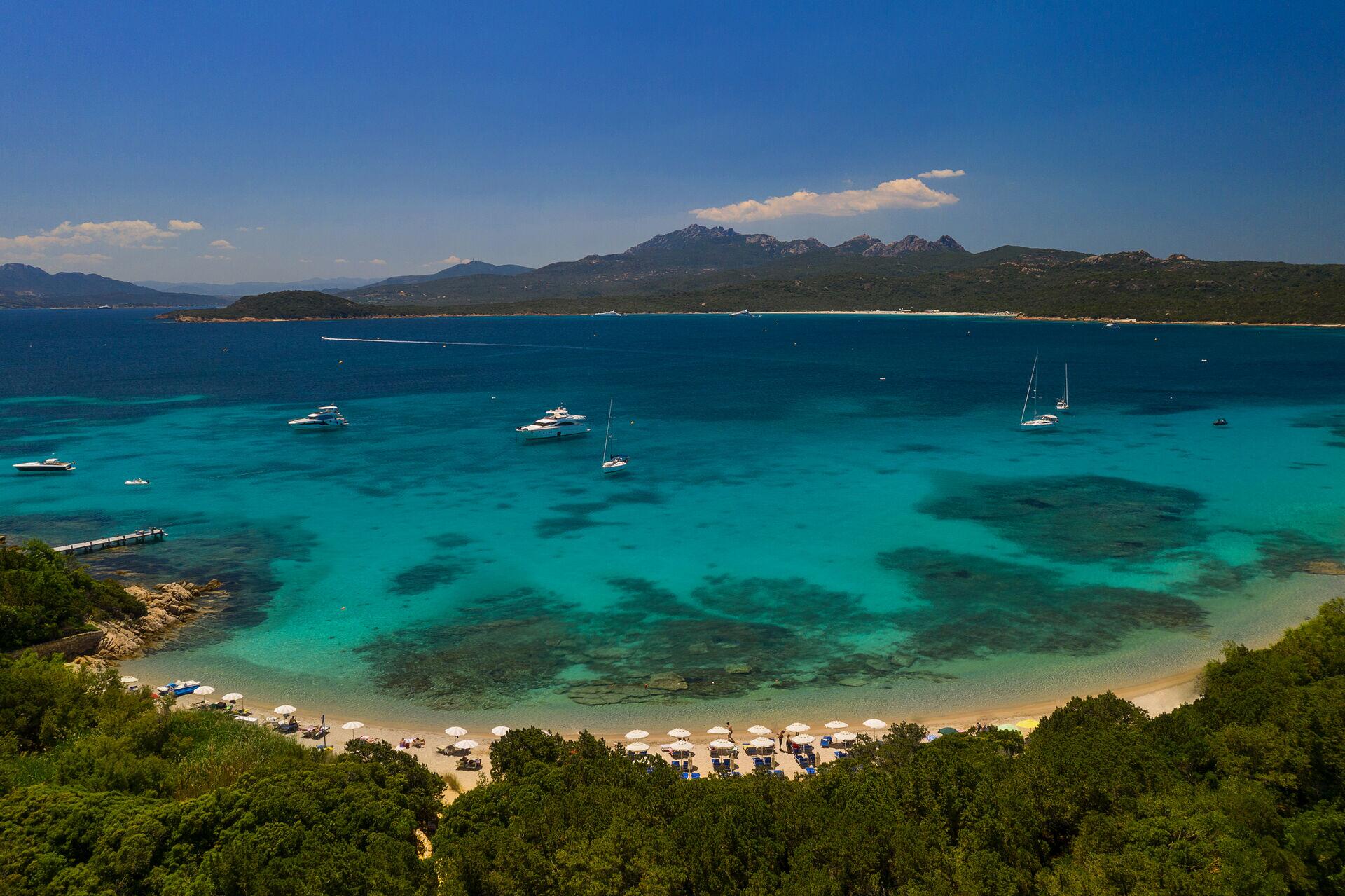
He instantly fell in love with the area's paradisiacal, largely untouched coastline, whose pink-white sands, vivid turquoise waters, granite formations, salt-water lagoons, maquis-scented brush, and emerald woodland combine to create a landscape of magical beauty.
Inspired by what he saw and with a clear vision in mind, the Aga Khan formed a consortium of investors that included Giuseppe Mentasti (the owner of San Pellegrino), Patrick Guinness (of the brewing family), John Duncan Miller (a banker), and René Podbielski (a writer). The consortium purchased thousands of hectares of land that stretched for about 20km along the coast from Liscia di Vacca in the north to Capriccioli to the south. In between these two points are the enchanting beaches of Grande Pevero, Romazzino, and Poltu Di Li Cogghj, this last also known as the Spiaggia del Principe, referencing the Aga Khan's particular fondness for it.
The vision
The Aga Khan's vision was to develop the area into an eco-friendly playground for the international jet-set and the super-rich. A group of prominent architects was engaged to make it happen, and soon Luigi Vietti, Michele Busiri Vici, Jacques Couëlle and a couple of others were drawing up plans.
The epicentre of the Costa Smeralda is Porto Cervo. Built from scratch, in many ways it's a latter-day version of Saltaire, Port Sunlight and Bournville, those model villages created by English philanthropist industrialists in the late 19th century. The project included everything a town might need: shops, squares, utilities, roads and other infrastructure, a church, hotels, homes, and a yacht club. But while those model villages mentioned above were built for factory workers, Porto Cervo was designed for the international jet-set.
A new architectural aesthetic is born
The Aga Khan imposed strict planning guidelines to safeguard and preserve as much as possible of the natural surroundings.
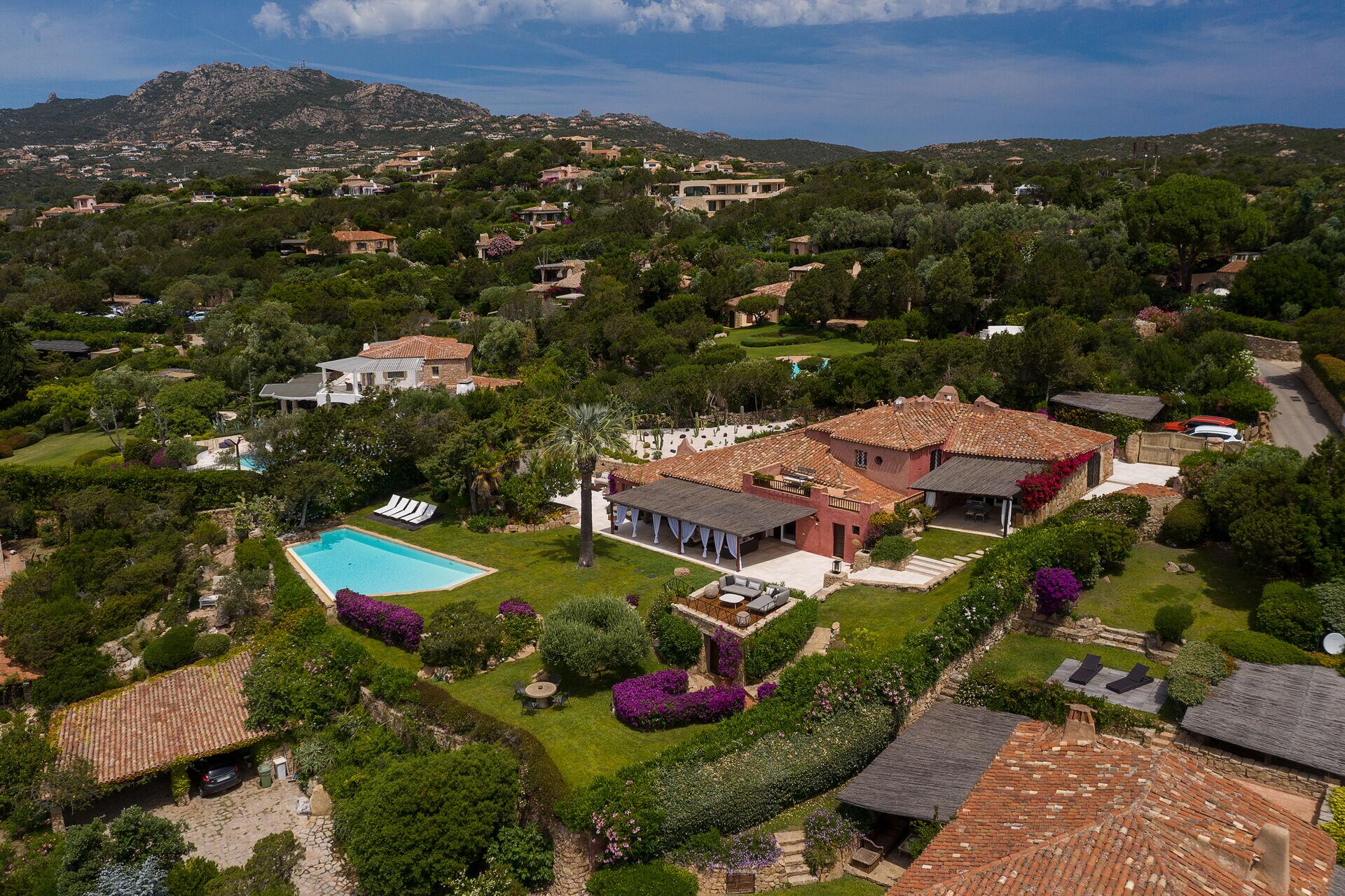
While working in slightly contrasting styles, the aforementioned architects embraced the fundamental tenets of what quickly became a whole new aesthetic: forms were rounded, curvaceous, and irregular, much like the area's monumental granite masses or the ancient remains of Sardinia's Nuragic civilisation; the preferred palette was a mix of white, faded russets, earthy ochres, and soft pinks (though Vietti sometimes went for bright colours); buildings appeared to emerge organically from the maquis and never rose above a certain, limited height; and the materials used, including juniper wood, granite, wrought-iron, decorative ceramics, and terracotta roof tiles, were manufactured by in local factories founded by the consortium.
All or most of these features can be found in the earliest buildings of the project, such as the Stella Maris church (Busiri Vici), La Maison du Port (the first home of the Costa Smeralda Yacht Club - Couëlle), and the hotels of Cervo (Vietti), Luci di La Muntagna (Busiri Vici), Pitrizza (Vietti) and Cala di Volpe (Couëlle). Numerous villas were also designed by these architects and their disciples, including our very own I Corbezzoli, the creation of Couëlle's son, Savin.
The world comes to the Costa Smeralda
The Costa Smeralda quickly became the success the Aga Khan had hoped for, and the area was soon welcoming Hollywood stars, royalty and the super wealthy. This tradition of catering to the world's movers and shakers continues today, and in high season the area's marinas are full to brimming with yachts of the rich and famous. Polo matches take place near Arzachena, and the Costa Smeralda Yacht Club regularly organises international regattas, including the Sardinia Cup.
The success of the Costa Smeralda may also be measured in environmental terms: the strict planning restrictions imposed by the Aga Khan all those years ago mean that there is no overdevelopment or endless strips of hotels seen in many parts of the Mediterranean; only a small percentage of the land originally acquired by the consortium has been built on; and the vast majority of the coastline remains as untouched and as paradisiacal as it was before the Aga Khan's arrival.
Porto Cervo, with its glamour and billionaire buzz is just one side of the Costa Smeralda. Its designer boutiques, excellent restaurants, top-drawer hotels and marina attract many, but if that's not your thing, you can simply retreat to the area's more hush-hush corners and immerse yourself in the extraordinary beauty of the Costa Smeralda's divine beaches, swim in its translucent waters, and explore its timeless, maquis-scented hinterland.
The south coast of Sardinia
Southern of Sardinia, from Capo Ferrato and the long sandy beach of Costa Rei in the east to the island of San Pietro in the west, is a captivating area, where prehistoric civilisations rub shoulders with Carthaginian and Roman sites, and verdant mountains slope gently down to paradisiacal beaches and coves.
The glamour of the Costa Smeralda in the north feels like another world, and it is no coincidence that those seeking simpler, more laid-back pleasures head for the south of Sardinia.
A history-filled capital city
Most people travelling to the south of Sardinia will either land or dock in Cagliari, the island's capital. Its old centre is full of charm, interest, and history (dating back several millennia). Its vibrantly coloured jumble of buildings rises up the side of a hill overlooking the harbour and there's a sense of intrigue that is alluring.
No matter what your interests are, you'll find something to discover, and there are plenty of restaurants, cafés and bars for when you need to rest, sip on a drink, or sample some local specialities.
Stepping back in time
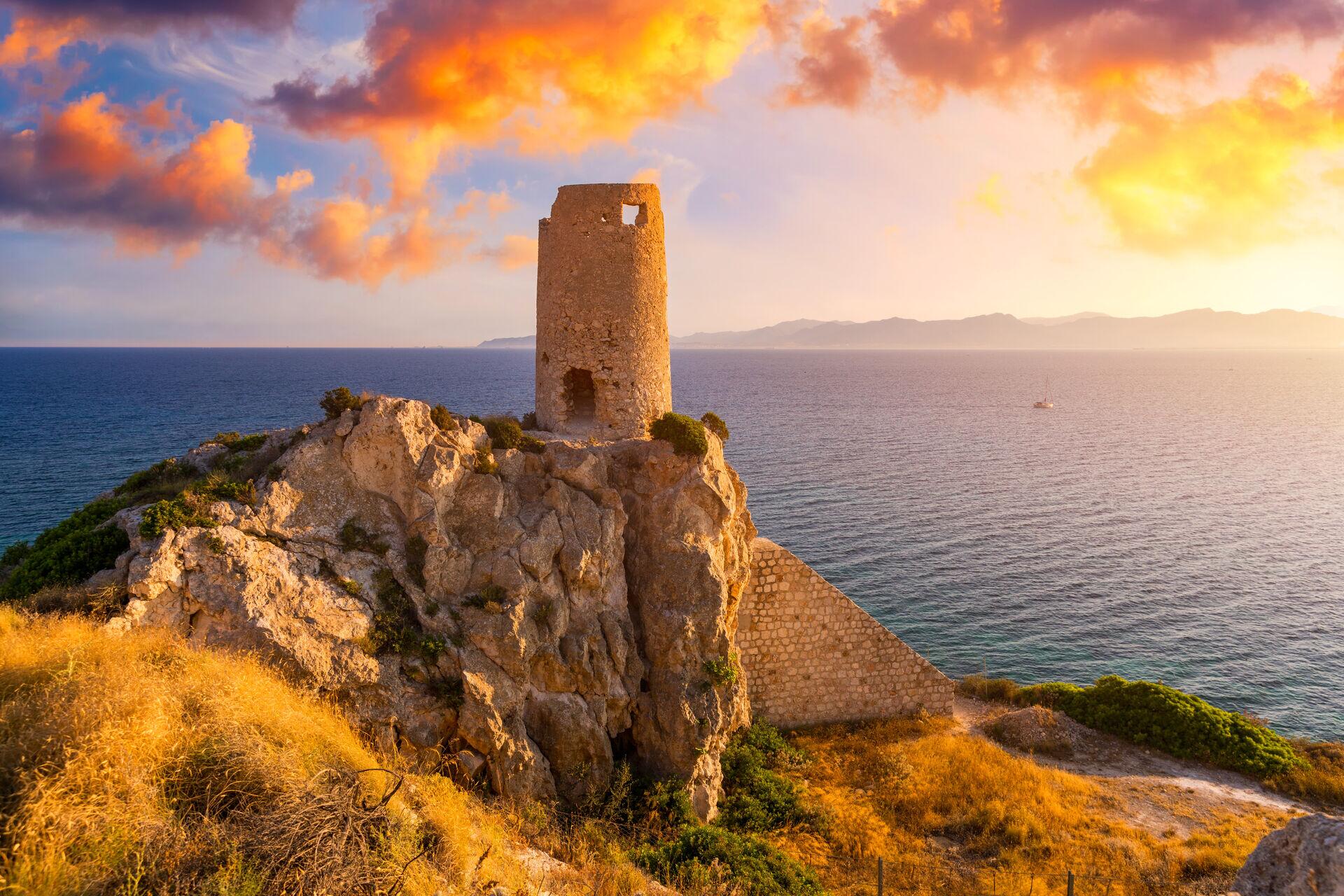
Sardinia's ancient Nuragic civilisation, which flourished from the 16th century BCE, has left its mark all over the island, and in the south there are numerous well-preserved sites to visit, including those at Monte Sirai (set on a hill above Carbonia in the west), and the Tomb of the Giants Is Concias (just outside Cagliari).
The Phoenicians, who established settlements and trading posts in southern Sardinia, were usurped by the Romans. They adapted and built over their predecessor's towns and monuments, with perhaps the most outstanding example found at Nora, located near the town of Pula, south of Cagliari.
Occupying an incredible position on a slender headland above the sea, Nora has given up numerous priceless artefacts, including its eponymous stone, a stele with an engraved text in the Phoenician language (now housed in Cagliari's archaeological museum). Exploring the site, you will come across the remains of a temple, a theatre that once seated 1,000 spectators, a nobleman's home with mosaic floors, thermal baths, cobbled streets, a necropolis and an aqueduct.
A beach for every occasion
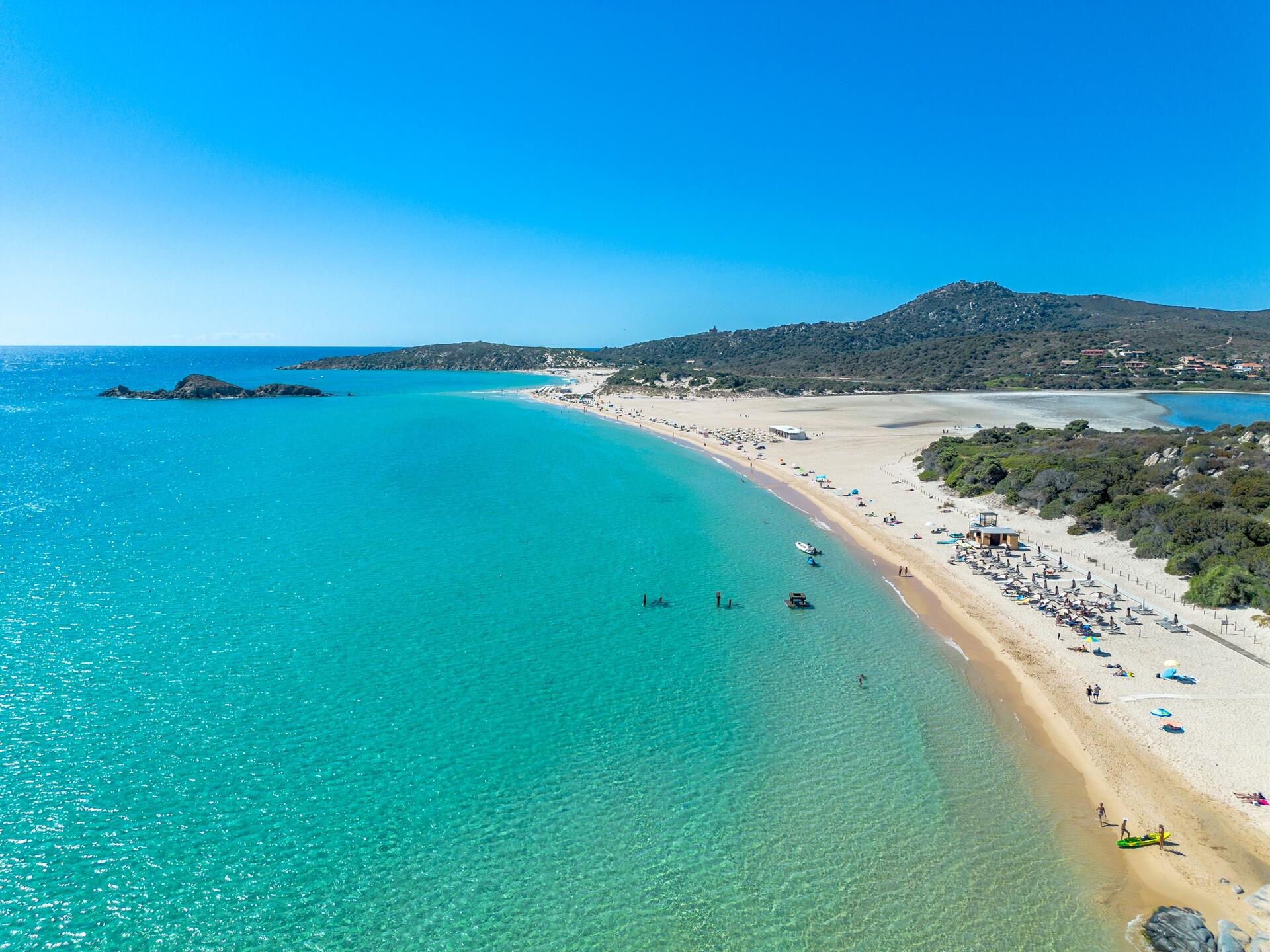
What most people will come to the south of Sardinia for are its numerous paradisiacal beaches, which include long stretches of sub-bleached sand, such as Costa Rei, Spiaggia del Poetto, Santa Margherita di Pula, Su Giudeu and Porto Pino, and myriad breathtaking bays, including those of La Cipolla, Cala de Sa Perda Longa, Piscinni, and Capo Zafferano.
Some of most spectacular coves, including the last one, are only accessible from the sea, meaning that it's great fun to rent a little boat for a day or two and explore the south coast.
All along the coastline of southern Sardinia, you'll come across salt-water lagoons, divided by spits of sand from the sea. If you're a keen twitcher or just love to see flamingos living their best life, it's worth visiting one or two.
Away from the coast
The south of Sardinia is home to three mountain ranges: the Sarrabus Mountains, northeast of Cagliari; the Sulcis Mountains, overlooking the southernmost tip of the island; and the Monte Linas Oridda Marganai, a regional park on the southwest coast. Each of these undisturbed, forested areas of outstanding natural beauty offer great walking trails, ravines, waterfalls, timeless Nuragic ruins, peaks rising to over 1,000m, and phenomenal views.
In the western foothills of the Sulcis Mountains, meanwhile, are the Is Zuddas caves, a series of dolomitic caverns dating back over 500 million years. Brimming with stalactites and stalagmites, the grotte are open to the public and there's a route of about 0.5km through some of the chambers.
Island life
Off the southwestern tip of Sardinia are two islands, Sant'Antioco and San Pietro. The former is connected to Sardinia by a slender isthmus and is the larger of the two. The latter is only accessible from the sea. Both islands were colonial outposts for the Phoenicians, the Carthaginians, and the Romans, and many priceless remains have been found during excavations.
Sant'Antioco is the resting place of its eponymous saint (the patron of the island and Sardinia as a whole), and a church dedicated to him, complete with ancient catacombs below, is a pilgrimage site. In the 16th century, Tunisian fishermen and coral-gatherers arrived in San Pietro. They were joined in the mid-17th century by Genoese fishermen, and both groups have had a profound influence on the culture, traditions, language and cuisine of the island.
Fishing continues to be one of the mainstays of the islands' economy, and you can see several tonnare (tuna processing stations) along the coast. Red tuna is still caught in the traditional way and it is greatly prized by the Japanese who buy as much of it as possible for the sushi market back home.
The islands' rugged hinterland drops down to sandy beaches, rocky cliffs, deep inlets and idyllic coves, and both are a pleasure to explore by boat.


Villa Matchmaking service
Because our local experts have personally visited each of our destinations, we know exactly what makes them special. Tell us what your ultimate villa holiday looks like, and allow us take care of the rest
